
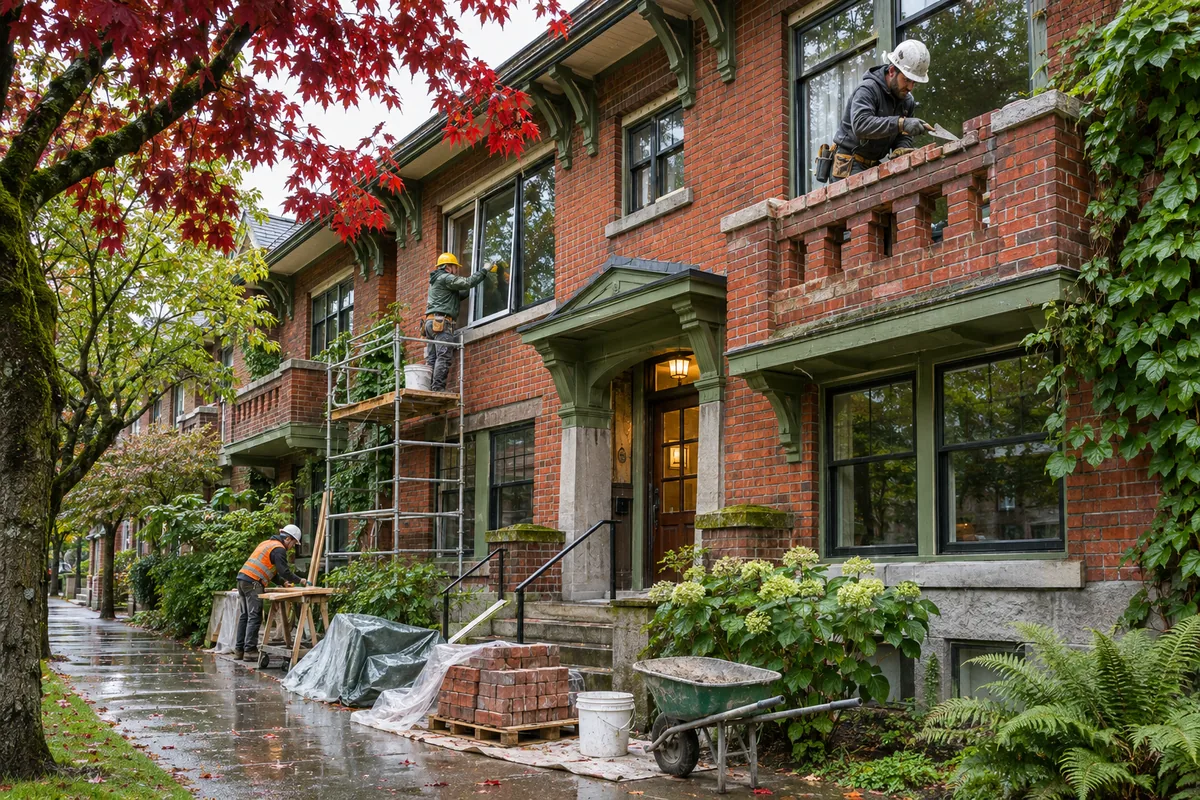
Spending on new homes and residential renovations in Canada fell for a fifth straight month in September 2026, as single-family construction dropped 3.4%. Statistics Canada reported on November 19, 2026, in its release on investment in building construction, that residential investment declined 0.8% to $15.9 billion, while gains in apartment and other multi-unit projects in Ontario and British Columbia softened the drop.
Figures are seasonally adjusted and in current dollars unless stated otherwise. Provincial, city and year-over-year comparisons are calculations from Table 34-10-0293-01. Statistics Canada revised its unadjusted data back to 2021 and its seasonally adjusted data back to 2018 with this release, so earlier months may differ from figures published before.
- Residential investment: down $127.0 million (−0.8%) to $15.9 billion in September 2026.
- Single-family homes: down $258.2 million (−3.4%) to $7.3 billion, led by Quebec (−$85.6 million) and Ontario (−$76.7 million).
- Multi-unit homes: up $131.2 million (+1.5%) to $8.6 billion, led by Ontario (+$152.4 million) and British Columbia (+$60.5 million).
- All building construction: down 0.2% to $23.4 billion, but 7.8% above September 2025. In constant 2023 dollars, it was up 3.9% year over year.
- Third quarter, constant dollars: residential investment fell $1.3 billion to $42.9 billion, with multi-unit spending down 3.9%.
- Next release: October data on December 18, 2026.
What the September numbers show
This survey measures the value of construction work put in place each month on residential and non-residential buildings, including new construction and renovations. It is different from building permits, which measure plans, and from housing starts, which count units when construction begins. Investment shows how much building activity is actually happening on sites across the country.
The September decline was driven by single-family homes. Eight provinces and one territory reported lower single-family investment, according to Statistics Canada. Multi-unit construction moved the other way, rising for a second month, though not everywhere: five provinces and two territories reported declines, led by Quebec (−$62.6 million).
Non-residential construction rose 1.0% to $7.5 billion. Institutional projects such as schools and hospitals rose 1.8% to $2.4 billion, industrial buildings rose 1.4% to $1.5 billion, and commercial construction edged up $8.0 million to $3.6 billion.
A five-month slide from the spring peak
Calculated from the revised table, residential investment peaked at $16.39 billion in April 2026 and has fallen every month since: to $16.30 billion in May, $16.13 billion in June, $16.12 billion in July, $16.06 billion in August and $15.93 billion in September. That is a cumulative decline of about 2.8% from April.
Over the full year the picture looks stronger. Residential investment in September was 7.4% higher than in September 2025 in current dollars. Much of that gain reflects higher prices rather than more building. In constant 2023 dollars, which remove the effect of construction cost changes, the year-over-year increase was about 3.6%. Statistics Canada's release shows the same gap for all building construction: up 7.8% in current dollars but 3.9% in constant dollars.
By type of home, single-family investment was 4.3% higher than a year earlier in current dollars but only about 0.5% higher in constant dollars. Multi-unit investment was up 10.2% in current dollars and about 6.3% in constant dollars. Multi-unit projects accounted for about 54% of residential investment in September, compared with about 49% in September 2020, a sign of how much new supply now comes from apartments, rows and other attached homes.
The third-quarter results show the slowdown more clearly. In constant 2023 dollars, residential investment fell to $42.9 billion, down $1.3 billion from the second quarter. Multi-unit spending fell $915.7 million (−3.9%) and single-family spending fell $347.7 million (−1.7%). Non-residential investment rose 1.9% in the quarter to $19.7 billion.
Renovations, not new homes, are driving the annual gain
Statistics Canada now publishes detail by type of work in its unadjusted, current-dollar series. Those figures, which are not seasonally adjusted, show where the year-over-year growth is coming from. In September 2026, residential new construction was worth $8.52 billion, up just 0.4% from September 2025. Residential renovations were worth $8.46 billion, up 16.1%. From January to September, new residential construction totalled $68.9 billion, about 0.2% less than in the same months of 2025, while renovation spending reached $67.9 billion, up 16.5%.
Our interpretation: owners appear to be putting more money into existing homes while spending on brand-new housing has stalled. Part of the increase likely reflects higher costs for labour and materials rather than more projects, since these figures are in current dollars and are not adjusted for price changes. For housing supply, the split matters because renovations improve existing homes but generally do not add new units, while new construction does.
Where construction rose and fell
Regional trends diverged in September. Calculated from the table, residential investment by province and territory changed as follows:
- Quebec: down $148.1 million (−3.5%) to $4.08 billion, with both single-family and multi-unit spending lower. Even so, Quebec remained 22.8% above September 2025, the strongest annual gain among the larger provinces. The Montréal census metropolitan area (CMA) fell $120.1 million on the month but was up 33.9% on the year.
- Ontario: up $75.7 million (+1.4%) to $5.40 billion, as a $152.4 million multi-unit gain outweighed lower single-family spending. Toronto rose $75.7 million (+3.1%), almost entirely from multi-unit projects. Ontario was up 3.6% on the year.
- British Columbia: up $24.4 million (+0.9%) to $2.60 billion, with multi-unit gains offsetting a $36.2 million drop in single-family spending; up 5.4% on the year. Vancouver rose 1.7%.
- Alberta: down $14.4 million (−0.8%) to $1.80 billion and 3.6% below a year earlier. Calgary edged down 1.1% on the month but was 8.5% above last year; Edmonton rose 3.0% on the month but was 19.6% lower than a year earlier.
- Manitoba: down $63.5 million (−9.1%), the largest percentage decline among provinces, mostly in Winnipeg single-family construction.
- Saskatchewan: up $17.0 million (+4.0%), and 24.1% above September 2025.
- Atlantic Canada: mixed. New Brunswick was 23.3% above last year, while Nova Scotia was 23.2% lower and Newfoundland and Labrador 24.0% lower. Halifax residential investment was 34.5% below September 2025.
Our interpretation: single-month regional numbers move a lot because one large project can start or finish in a given month, especially in smaller provinces and cities. The year-over-year comparisons and quarterly totals are a better guide to the trend than any single month.
How it fits with permits, starts and rates
The investment data line up with other recent construction indicators. Statistics Canada reported on November 12 that the value of building permits fell 4.1% in September to $12.9 billion, with multi-family permits down $529.3 million, led by British Columbia and Alberta. Permits are an early signal: a drop in multi-family approvals in those provinces could show up in investment spending several months later. CMHC reported on November 17, 2026, that the six-month trend in housing starts declined 1.7% in October to 246,231 units (see our October housing starts coverage). CMHC also reported that pending starts, meaning units with approved permits that have not yet started, fell 3% to 139,592 in centres of 50,000 or more, and said the drop "suggests some softness in the near-term construction pipeline."
Interest rates matter here too. Builders finance projects with construction loans that are usually priced off prime or short-term rates, and buyers of new homes need mortgage approval at completion. On October 28, 2026, the Bank of Canada raised its policy rate to 2.5% and said it expects housing "to remain relatively weak." The September investment data were collected before that increase took effect.
This release follows August's report, when residential construction spending dipped as single-family building slowed. September extends the same pattern: single-family weakness, multi-unit resilience in Ontario and British Columbia, and a widening gap between current-dollar and constant-dollar growth.
What it means and who is affected
Buyers of new detached homes. Lower single-family investment in most provinces suggests fewer detached homes moving through construction. Our interpretation: in markets where builders have pulled back, buyers may see fewer new detached options and should compare resale listings as well. Where demand is also soft, some builders may offer incentives; check what is included in writing.
Buyers of pre-construction condos and townhomes. Multi-unit activity is concentrated in Ontario and British Columbia. If you are buying a unit that will not be finished for a year or more, your mortgage approval will be based on rates and your finances at completion, not today. Ask your lender how long a rate hold lasts and plan for the possibility of higher rates by closing. Realtors who focus on new developments are listed under pre-construction realtors.
Owner-builders and small builders. Construction financing is usually advanced in draws as work is completed and inspected. Slower activity and higher rates can make lenders more cautious about costs and timelines. Compare terms from several construction lenders and confirm draw schedules, inspection fees and holdbacks before work begins.
Renters. Multi-unit investment includes purpose-built rentals as well as condominiums, and the survey does not separate the two. Continued spending on these projects in large Ontario and B.C. cities may add rental supply over the next few years, but the third-quarter decline in multi-unit spending is a reminder that the pipeline can slow.
Homeowners planning renovations. Residential investment includes renovation work. Construction costs have been rising, which is why current-dollar spending is growing faster than constant-dollar activity. Get several written quotes and build a contingency into any renovation budget.
What to watch and what to do next
- December 9, 2026: the Bank of Canada's next scheduled rate announcement.
- December 18, 2026: Statistics Canada's investment in building construction data for October, the first month after the rate increase.
- CMHC's next monthly housing starts release, which will show whether the drop in pending starts carries into actual construction.
- If you are buying new, ask the builder for the expected completion date in writing and what happens to your deposit if it is delayed; rules differ by province.
- If you need financing at completion, get pre-approved and ask how your lender treats rate increases between signing and closing.
- If you are building, get a written draw schedule and confirm what the lender's inspector must see before each advance.
For a new-build purchase or a construction project, a licensed mortgage professional who works with construction and completion financing can explain how draws, rate holds and closing approvals work with your timeline.
Sources
- Statistics Canada, Investment in building construction, September 2026 (The Daily), 2026-11-19. Accessed 2026-11-20.
- Statistics Canada, Table 34-10-0293-01, Investment in building construction, updated 2026-11-19. Accessed 2026-11-20.
- Statistics Canada, Building permits, September 2026 (The Daily), 2026-11-12. Accessed 2026-11-20.
- Canada Mortgage and Housing Corporation, Housing starts and construction data for October 2026, 2026-11-17. Accessed 2026-11-20.
- Bank of Canada, Bank of Canada raises the policy rate by 25 basis points to 2½%, 2026-10-28. Accessed 2026-11-20.
This article is general information, not financial advice. Figures are from Statistics Canada, CMHC and the Bank of Canada as of the dates shown and may be revised. Speak with a licensed professional about your own situation.