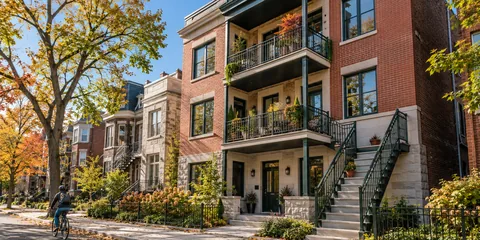
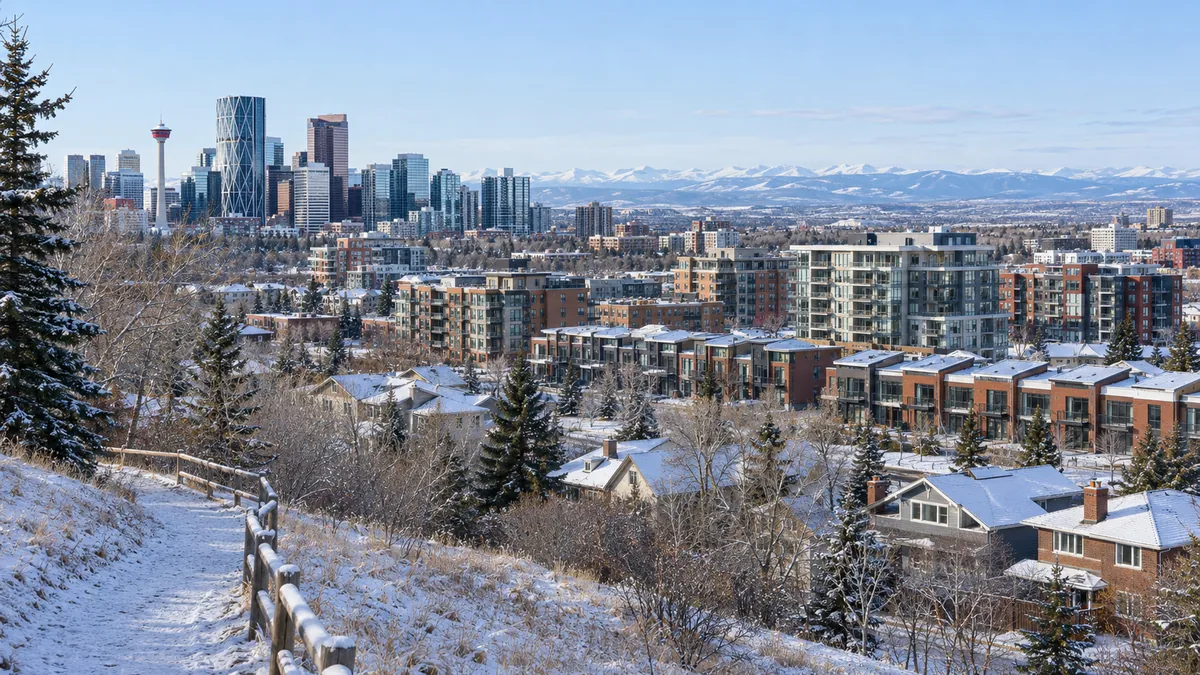
The Calgary Real Estate Board (CREB) reported on November 2, 2026 that October home sales in the city slowed to 1,592, down about 15% from October 2025. New listings fell too, so inventory eased and the overall benchmark price held close to last year's level. The weakness remains concentrated in apartment condominiums and row homes, while detached and semi-detached homes stay closer to balanced.
- City of Calgary sales, October 2026: 1,592, down 15.3% year over year; year-to-date sales down 10.9% (CREB monthly statistics package).
- New listings: 2,928 (down 9.4%). Inventory: 6,173 (down 4.6%). Months of supply: 3.88, up from 3.44 a year earlier.
- Total residential benchmark price: $564,200, down 0.35% from October 2025 (unadjusted).
- Benchmark by type: detached $735,100; semi-detached $685,200; row $407,500; apartment $288,800.
What the October numbers show
CREB says sales fell across all property types, with the steepest pullbacks in resale apartments and row homes. Because new listings dropped as well, inventory declined in line with the usual fall pattern and was nearly 5% below October 2025. With just under four months of supply, the market overall sits between balanced and buyer-leaning, but the split by property type matters more than the average.
Detached and semi-detached: roughly balanced
Detached sales eased to 847, nearly 16% below last year, but the sales-to-new-listings ratio rose to 56% and supply was just over three months. The detached benchmark was less than 1% lower than a year earlier. CREB notes wide district differences: City Centre and West reported year-to-date price gains, while North East prices are down more than 6%. Semi-detached homes were the tightest segment, with a 61% sales-to-new-listings ratio and a benchmark nearly 1% above last year.
Row and apartment: more supply, lower prices
Row homes had 4.4 months of supply and a benchmark more than 5% below October 2025. Apartments had over five months of supply, and the benchmark was 8% lower than a year earlier and 15% below the August 2024 peak, according to CREB. The board links this to competition from new construction and added rental supply.
Who is affected
Our interpretation: Buyers looking at condos and townhomes have more choice and more room to negotiate than detached buyers. Owners planning to sell an apartment or row unit, or to refinance one, should expect valuations to reflect the recent declines. Anyone buying in Calgary is also doing so after the Bank of Canada raised its policy rate by 25 basis points to 2.5% on October 28, 2026, which lifts variable-rate borrowing costs (more in our rate decision coverage).
What to check next
- Look at district and property-type data, not the city-wide average, before setting an offer or list price.
- Get a pre-approval and run the numbers with the mortgage affordability calculator.
- For a refinance or a purchase in a segment where prices are falling, a lender may order an appraisal; local Calgary appraisers can explain how recent sales are used.
- Compare financing options with a Calgary mortgage professional and confirm their licence with the provincial regulator.
Sources
- Calgary Real Estate Board, Supply levels ease as we move into winter, 2026-11-02. Accessed 2026-11-03.
- Bank of Canada, Bank of Canada raises the policy rate by 25 basis points to 2½%, 2026-10-28. Accessed 2026-11-03.
- Calgary Real Estate Board, City of Calgary Monthly Statistics, October 2026 (PDF), 2026-11-02. Accessed 2026-11-03.
This article is general information, not financial, legal or real estate advice. Figures are CREB's as published and may be revised. Speak with a licensed professional about your situation.